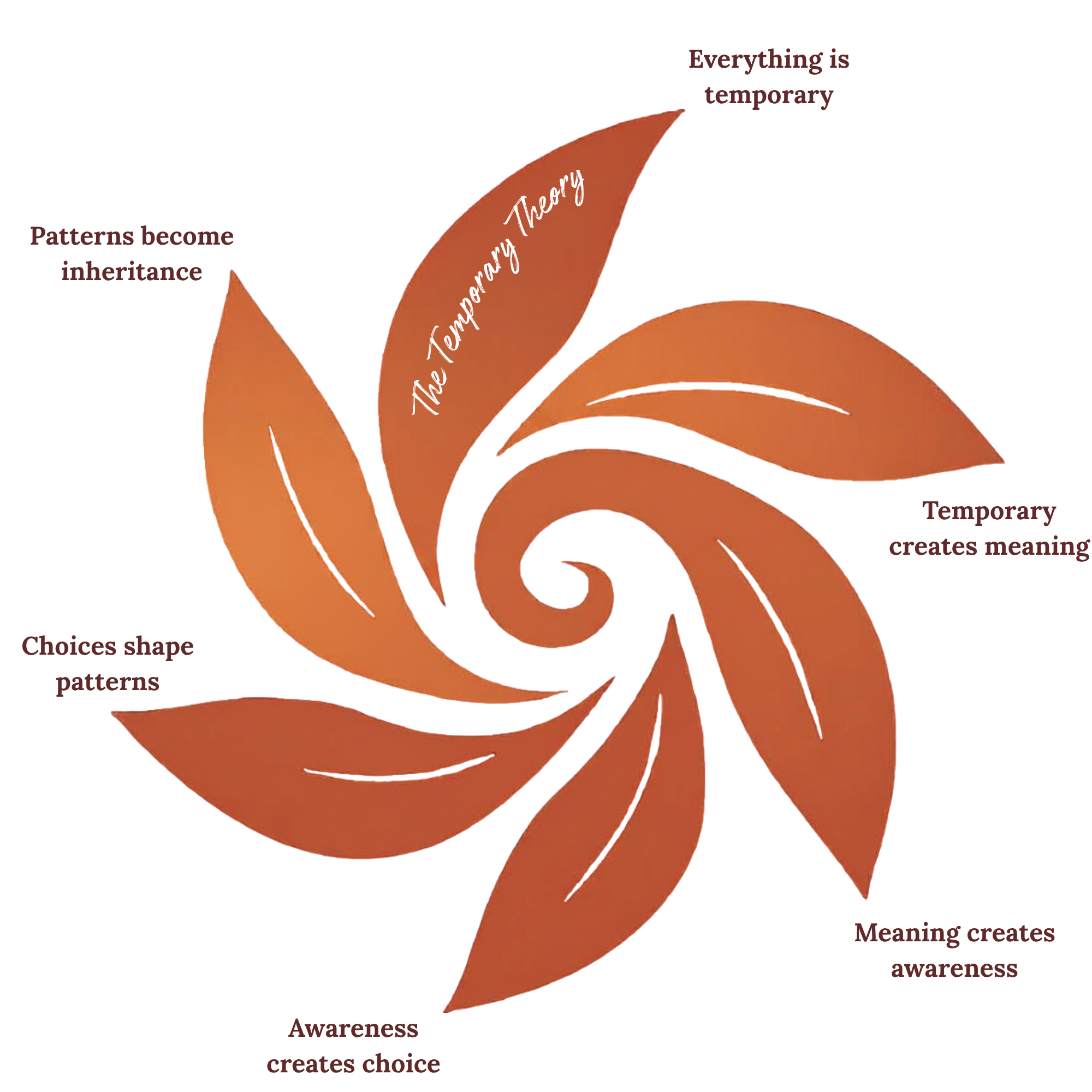
The Temporary Theory

The Temporary Theory is the philosophical foundation of Explore Your Brilliance.

It is built on one steady truth: nothing we experience is permanent — yet everything we experience matters.

Rather than minimising pain or bypassing emotion, the Theory provides language and structure for understanding change, resilience, connection, and growth across the lifespan.

Grounded in lived experience and aligned with established psychological and behavioural research, it brings these concepts together into one accessible, cohesive framework — centred on impermanence.

The Research Foundations Behind the Six Principles

The Temporary Theory is grounded in lived experience and aligned with established research across psychology, emotional intelligence, trauma recovery, and resilience science.

While it is not a clinical intervention, the framework reflects decades of research demonstrating that emotional safety, connection, presence, meaning, and adaptability are central to human wellbeing.

An Integrative Framework

Individually, each principle reflects established research domains.

Together, they form an integrated emotional literacy framework.

The Temporary Theory translates research-aligned concepts into accessible language, creating a cohesive philosophy that supports emotional regulation, resilience, self-understanding, and connection.

It is not therapy.
It is not a clinical model.

It is a grounded, research-aligned framework designed to complement personal growth and professional practice.

A research-aligned philosophy grounded in impermanence.

The Temporary Theory integrates concepts aligned with established bodies of work across psychology, behavioural science, and emotional development.

While not a clinical intervention, it reflects research demonstrating that emotional safety, connection, presence, meaning, and adaptability are central to human wellbeing.

1. Temporary Still Matters

Moments do not need to last forever to shape who we become.

Research in existential psychology and narrative identity theory suggests that even brief experiences influence memory, identity, and long-term meaning-making. Scholars such as Viktor Frankl and Robert Neimeyer have demonstrated that resilience increases when individuals can integrate both painful and joyful experiences into their life story.

Positive psychology research (Barbara Fredrickson) further indicates that even small moments of emotional significance broaden cognitive flexibility and build enduring psychological resources.

Temporary experiences may pass, but their impact can remain.

2. You Are Not Alone

Connection is not optional — it is biological.

Attachment theory (Bowlby; Ainsworth) and belongingness research (Baumeister & Leary) consistently demonstrate that humans are wired for relational connection. Social Baseline Theory (James Coan) suggests that the nervous system regulates more effectively in the presence of trusted others.

Connection reduces physiological stress responses and strengthens resilience.

Meaning is often found in connection.

3. Presence Over Perfection

Progress does not require perfection.

Mindfulness research (Kabat-Zinn; Brown & Ryan) demonstrates that present-moment awareness reduces anxiety and rumination. Self-compassion research (Kristin Neff) shows that reducing harsh self-criticism strengthens resilience and sustainable motivation.

Acceptance-based models such as Acceptance and Commitment Therapy (Steven Hayes) highlight that psychological flexibility — not flawlessness — predicts wellbeing.

Growth emerges through presence, not pressure.

4. Emotion Has Intelligence

Emotions carry information.

Emotional intelligence research (Mayer; Salovey; Goleman) shows that the ability to understand and regulate emotions predicts relational effectiveness, leadership capacity, and personal wellbeing.

Affect-as-information theory (Schwarz & Clore) suggests emotions guide decision-making processes. Emotion regulation research (James Gross) further confirms that emotional awareness underpins adaptive coping.

Emotions carry meaning - and they all matter.

5. Healing Is Not Linear

Growth unfolds in cycles, not straight lines.

Trauma recovery models (Judith Herman; Bessel van der Kolk) and post-traumatic growth research (Tedeschi & Calhoun) demonstrate that healing is rarely sequential. Setbacks and returns are part of integration, not evidence of failure.

Resilience research supports the view that progress is dynamic and adaptive rather than linear.

Healing moves in circles and spirals — and it is still growth.

6. Impermanence as Hope

Change is constant — in difficulty and in joy.

Resilience science (Ann Masten) highlights adaptive systems that allow individuals to recover from adversity. Hope theory (C.R. Snyder) shows that perceived pathways and agency increase psychological endurance.

Research on temporal distancing suggests that stepping back and recognising that experiences are not permanent can reduce emotional overwhelm and catastrophic thinking.

Change can feel unsettling, yet it often carries us forward.

Six principles.
One unifying truth.
Everything is Temporary.

Individually, each principle reflects established research domains.

Together, they form a cohesive emotional literacy framework grounded in impermanence.

The strength of The Temporary Theory lies not in any single idea -
but in their integration.

Below is an overview of how each principle aligns with contemporary research domains.

4. Emotion Has Intelligence

Emotions carry information.

Rather than being obstacles, emotions provide data about needs, boundaries, values, and relational dynamics. When understood and regulated, they support clearer decision-making and stronger relationships.

Emotions are data — not defects.

Research Domains

• Emotional intelligence research (Mayer; Salovey; Goleman)
• Affect-as-information theory (Schwarz & Clore)
• Emotion regulation research (Gross)
• Affective neuroscience
• Decision-making research

These domains confirm that emotional awareness and regulation are central to relational effectiveness, leadership capacity, and personal wellbeing.

5. Healing Is Not Linear

Growth unfolds in cycles, not straight lines.

Healing includes pauses, setbacks, returns, and breakthroughs. Progress is dynamic and adaptive — not sequential or predictable.

Healing moves in spirals, not ladders.

Research Domains

• Trauma recovery models (Herman; van der Kolk)
• Post-traumatic growth research (Tedeschi & Calhoun)
• Resilience science (Masten)
• Developmental psychology
• Adaptive systems theory

These research fields show that recovery and growth are nonlinear processes shaped by integration, context, and support.

6. Impermanence as Hope

Everything shifts — in difficulty and in joy.

Impermanence is not instability; it is possibility. The recognition that emotional states, seasons, and circumstances change provides psychological endurance and perspective.

Change is not the enemy. It is the stabiliser.

Research Domains

• Resilience science (Masten)
• Hope theory (Snyder)
• Cognitive reappraisal and temporal distancing research
• Stress adaptation research
• Positive psychology

Individually, each principle reflects established research domains. These domains demonstrate that recognising change as dynamic reduces catastrophising, increases agency, and strengthens long-term psychological endurance.

The research domains referenced represent established bodies of work in psychology and behavioural science. The Temporary Theory integrates concepts aligned with these domains but does not claim clinical validation or endorsement by any individual scholar.

1. Temporary Still Matters

Moments do not need to last forever to shape who we become.

Temporary experiences — whether painful or joyful — influence memory, identity, trust, and growth. The impact of an experience is not determined by its duration, but by the meaning we attach to it.

Temporary experiences are not trivial — they are formative.

Research Domains

• Existential psychology
• Narrative identity theory
• Meaning-making research (e.g., Frankl; Neimeyer)
• Positive psychology and broaden-and-build theory (Fredrickson)
• Developmental psychology

These research domains demonstrate that even brief emotional experiences can influence long-term resilience, cognitive flexibility, and identity formation.

2. You Are Not Alone

Connection is not optional — it is biological.

Human beings are wired for belonging. Emotional safety, co-regulation, and relational support strengthen resilience and wellbeing.

We are not designed to navigate life in isolation.

Research Domains

• Attachment theory (Bowlby; Ainsworth)
• Belongingness research (Baumeister & Leary)
• Social Baseline Theory (Coan)
• Interpersonal neurobiology
• Social support and stress-buffering research

These fields consistently show that connection regulates the nervous system, reduces stress responses, and strengthens adaptive capacity.

3. Presence Over Perfection

Progress does not require perfection.

Growth emerges through presence — the willingness to engage with the current moment — rather than through performance, pressure, or self-criticism.

Psychological flexibility strengthens resilience more than flawlessness ever could.

Research Domains

• Mindfulness-based research (Kabat-Zinn; Brown & Ryan)
• Self-compassion research (Neff)
• Acceptance and Commitment Therapy (Hayes)
• Psychological flexibility research
• Cognitive-behavioural models

These research areas demonstrate that present-moment awareness and self-compassion reduce anxiety, rumination, and perfectionistic distress while supporting sustainable motivation.

Together, the principles form an integrated emotional literacy framework grounded in impermanence.